







Related News
Contact Us
Steel Building Manufacturers: How to Vet a Supplier
2026-08-10
Vetting a steel building manufacturer means checking eight things a sales page rarely volunteers: production line type, prefabrication ratio, structural standard compliance, quality system currency, export packaging method, container loading calculations, shipping documentation support, and installation scope. Ask for evidence on each before signing a deposit.
Most manufacturer websites read the same way: photos of a factory floor, a list of building types, a contact form. None of that tells a distributor or agent whether the supplier can actually get a compliant structure onto a container and through customs at the destination port. The checklist below is built around what a buyer needs to confirm, not what a seller wants to show.
Why the Standard Homepage Checklist Fails Overseas Buyers
Domestic-market manufacturer sites — the kind that dominate search results for “steel building manufacturers” — are written for buyers who never touch export logistics. They talk about spans, gauges and warranty years, then stop. For an overseas distributor sourcing from China, that’s half the picture. The other half — packaging method, container utilization, customs paperwork, and who handles installation once the container lands — determines whether a project finishes on schedule or stalls at the port. Compared to catalog-based domestic suppliers, an export-focused manufacturer has to answer questions that never come up in a local sale.
The Vetting Checklist
1. Production Line Type
Ask whether the manufacturer runs its own roll-forming or RCB (roll-cold-bending) lines, or subcontracts fabrication to a third party. A supplier operating in-house production lines controls tolerances and lead times directly; one that subcontracts is really a trading intermediary, which adds a layer of quality risk and margin you’re not seeing. Request the equipment brand, line count, and — if possible — a live video walkthrough rather than static photos, since photos can be reused across multiple company sites.
2. Prefabrication Ratio for Your Project Type
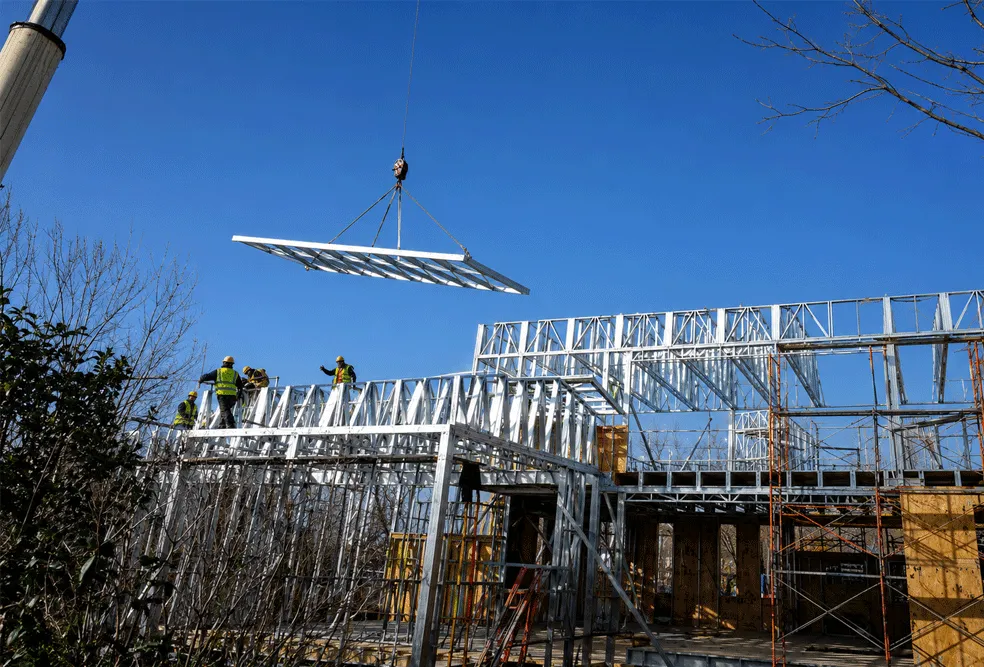
“Prefabricated” is used loosely across the industry. Ask what percentage of the structure — by weight or by component count — leaves the factory pre-cut, pre-drilled and surface-treated, versus what gets fabricated on-site. A higher factory-prefabrication ratio generally means less on-site welding and cutting, which matters most in locations where skilled site labor is scarce or expensive. Get this number in writing for your specific building type, not as a generic company-wide claim.
3. Structural Standard Compliance
Confirm which design code the manufacturer’s engineering team works to for your destination country. In North America that’s typically ANSI/AISC 360-22 for structural steel and ASCE/SEI 7-22 for load criteria; in the EU it’s the EN 1993 (Eurocode 3) series. A manufacturer that can name the applicable standard and produce a structural calculation report for your specific wind, snow and seismic loads is operating differently from one that quotes a generic “meets international standards” line with no document behind it.
4. Quality Management System Currency
Ask for a scanned, current ISO 9001:2015 certificate — not a photo of a plaque, and not a certificate whose validity window has already closed. Certification bodies issue these with fixed expiry dates, typically three years, and a supplier’s own historical certificate can lapse without a homepage update reflecting it. Cross-check the certificate number against the issuing body’s public registry if one is available; this single step catches more misrepresentation than any other item on this list.
5. Export Packaging Method
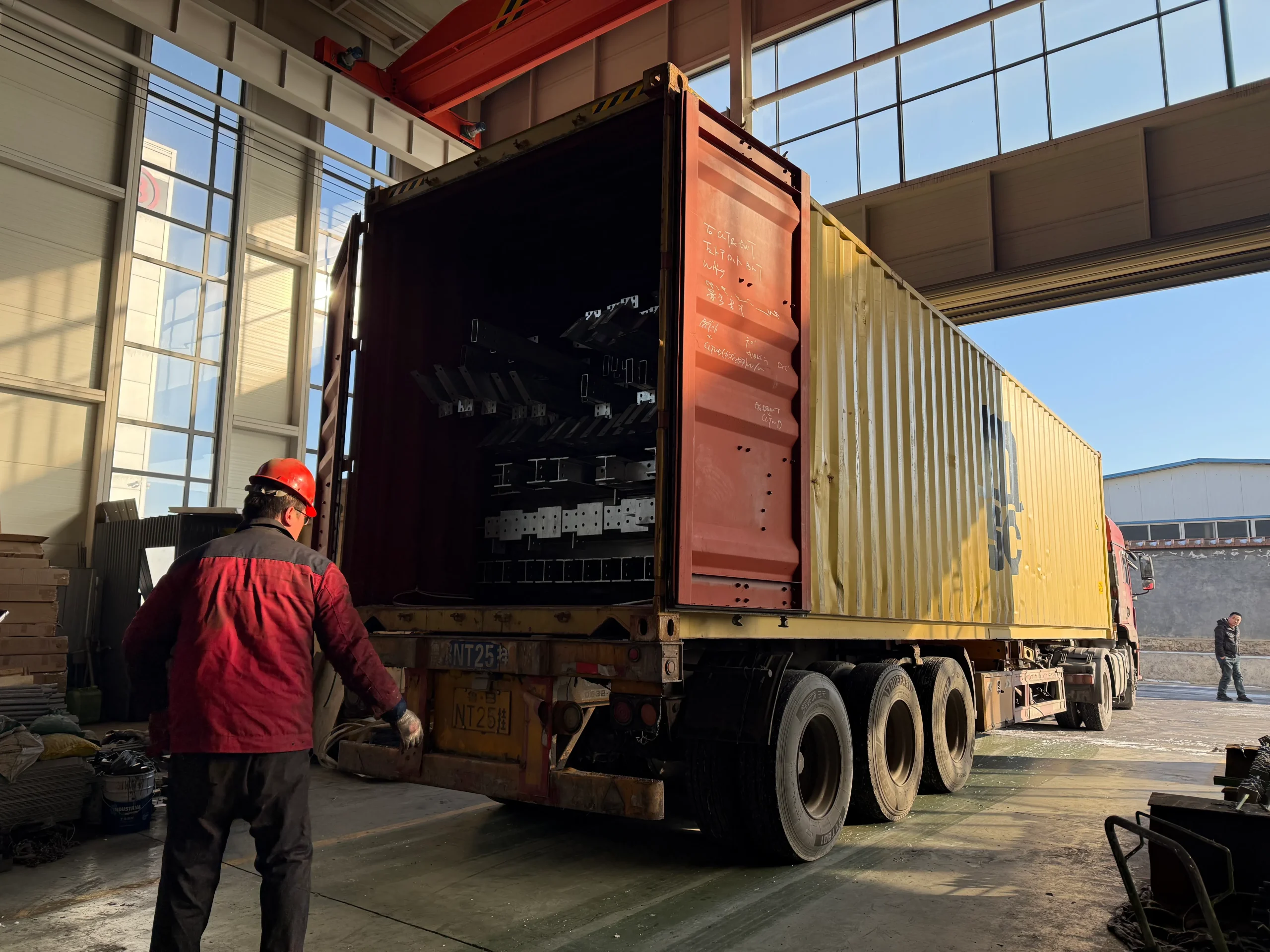
Steel components shipped loose in a container behave differently from components bundled, labeled and cushioned for a specific vessel route. Ask how the manufacturer packages for sea freight: bundling method, corrosion protection during transit, and whether components are numbered to match an installation drawing. A supplier that can’t describe packaging beyond “we wrap it well” hasn’t shipped enough export volume to have a repeatable process.
6. Container Loading and Calculation
A manufacturer experienced in export work will run a loading plan before fabrication starts — matching component dimensions to container internal dimensions to minimize the number of containers per project. Ask to see a sample loading plan from a comparable project. This isn’t a decorative extra: getting it wrong means paying for an extra container, or worse, discovering a component doesn’t fit once it’s already at the port.
7. Shipping Documentation and Customs Support
Confirm whether the manufacturer’s team handles bill of lading, packing list, certificate of origin and any destination-specific import documentation, or whether that’s left entirely to your freight forwarder. Suppliers who coordinate directly with customs brokers on the destination side tend to catch document mismatches before the shipment arrives rather than after.
8. Installation Guidance Scope
Ask precisely where the manufacturer’s responsibility ends: shipping instructions only, remote technical support during erection, or an engineer dispatched to site. Get this in the contract, not just the sales conversation — “installation support” without a defined scope is one of the more common gaps between what’s promised and what’s delivered on export projects.
How to Run the Audit
- Request the ISO 9001 certificate and structural calculation sample first. These are the two documents most often missing or outdated, and they filter out unqualified suppliers before you spend time on anything else.
- Schedule a live video call of the production floor. Ask the supplier to walk the camera past the actual roll-forming or RCB lines in operation, not a pre-recorded promotional clip.
- Request a sample export packaging photo set from a completed project, ideally one shipped to a climate or route similar to yours.
- Ask for an itemized FOB quote, broken down by steel structure, roof and wall system, doors and windows, and shipping. A quote that bundles everything into a single per-square-meter figure makes it hard to compare suppliers or negotiate line items.
- Get the installation support scope in writing as a contract clause, including who pays for an engineer’s travel if on-site support is included.
- Verify the factory address independently — through satellite imagery or a local sourcing agent — rather than relying solely on the address printed on the company’s own materials.
What a Transparent Manufacturer Discloses: A Reference Example
Sinomega operates two Japanese RCB steel-structure production lines at a 7,500 m² production base in Qingdao, Shandong Province, with more than 30 staff across an in-house R&D department and an overseas business department. The factory sits roughly 40 minutes from the airport and about an hour from Qingdao Port, which shortens the loop between fabrication and container loading. This is the level of specificity a buyer should expect from any supplier’s answer to items 1 and 8 above — not as a claim to be taken on faith, but as the kind of detail that can be independently checked against a video call or a factory visit.

A Common Misconception: Certificates Prove Current Capability
Buyers often treat any ISO or CE certificate displayed on a website as evidence of current compliance. It isn’t, by default. Certifications carry expiry dates, and a certificate scanned onto a webpage in one year can still be sitting there long after it lapses. The same caution applies to certificates issued to a related but legally separate entity — a parent company, a material supplier, or a sister factory — which don’t automatically transfer to the manufacturer you’re contracting with. Always ask for the certificate number and check the issue and expiry dates yourself; don’t take a certificate’s presence on a page as proof of anything beyond the fact that it existed at some point.
Trade-Off to Weigh: Project-Engineered vs. Catalog Systems
Manufacturers who engineer each project from scratch, rather than selling from a fixed catalog of standard models, can match a structure precisely to local wind, snow and seismic loads and to specific site constraints. The trade-off is lead time: engineering a bespoke structural calculation takes longer than pulling dimensions from a pre-approved catalog model, so buyers on a tight schedule should ask for a design-phase timeline up front rather than assuming project-engineered means slower delivery across the board — it depends on how much of the engineering process the manufacturer has already templated internally.
FAQ
Q: Should I ask for references from previous overseas buyers?
A: Yes, and ask specifically for a contact at a project shipped to a climate or region comparable to yours, since packaging and corrosion-protection needs vary significantly between, for example, a dry inland site and a coastal island project.
Q: Is a lower FOB price per square meter always the better deal?
A: Not by itself. A lower headline price with a bundled quote can hide gaps in what’s included — surface treatment, insulation thickness, or accessories — that surface as change orders later. An itemized quote is the only way to compare suppliers fairly.
Q: How do I confirm a supplier isn’t just a trading company reselling another factory’s output?
A: A live video walkthrough of the production floor, matched against the equipment brand and line count they claim, is the most reliable check. Trading companies typically can’t produce this without delay or substitution.
Q: What’s a reasonable amount of time to expect for this vetting process?
A: Document review and a video call can be completed within a week for a responsive supplier. Independent factory-address verification and reference checks typically add another one to two weeks.